+86-28-82633987sales@biopurify.com


Cys-5CQA-1CAS No.:
|
||||||||||
 |
|
|
||||||||
|
|
||||||||||
| Catalogue No.: | BP2461 |
| Formula: | C19H25NO11S |
| Mol Weight: | 475.465 |
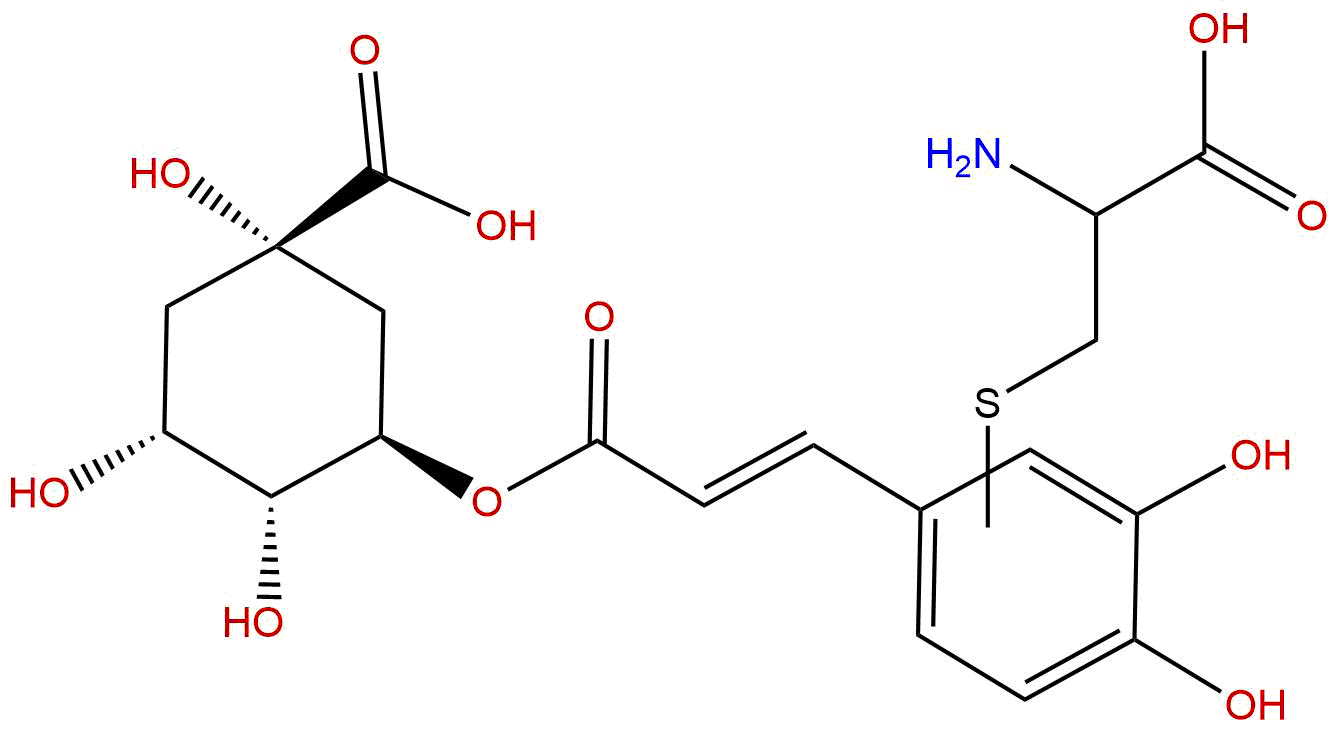
Product name: Cys-5CQA-1
Synonym name: Cysteine-5-Caffeoylquinic Acid Adduct I
Catalogue No.: BP2461
Cas No.:
Formula: C20H27NO11S
Mol Weight: 475.465
Botanical Source:
Type of Compound: Phenylpropanoids
Purity: 95%~99%
Analysis Method: HPLC-DAD or/and HPLC-ELSD
Identification Method: Mass, NMR
Packing: Brown vial or HDPE plastic bottle
Storage: Store in a well closed container, protected from air and light. Put into refrigerate or freeze for long term storage.
Whenever possible, you should prepare and use solutions on the same day. However, if you need to make up stock solutions in advance, we recommend that you store the solution as aliquots in tightly sealed vials at -20℃. Generally, these will be useable for up to two weeks.
The product could be supplied from milligrams to grams
Inquire for bulk scale.
Cys-5CQA (Cysteine-5-Caffeoylquinic Acid Adduct) refers to the covalent adduct formed by the reaction between L-cysteine (Cys) and 5-caffeoylquinic acid (5-CQA, commonly known as chlorogenic acid).
This compound is an active area of research within food chemistry (particularly coffee research), metabolomics, and pharmaceutical safety.
Core Chemical and Physical Characteristics
• Formation Mechanism: Under specific conditions—such as alkaline environments or oxidative stress—the catechol moiety of 5-CQA is oxidized into its reactive o-quinone form. The highly nucleophilic thiol group (-SH) of cysteine then attacks this o-quinone via a Michael addition, yielding the covalent Cys-CQA adduct.
• Mass Spectrometry (MS) Features: In LC-MS (Liquid Chromatography-Mass Spectrometry) analysis, this mono-adduct (derived from 5-CQA with a molecular weight of ~354 and Cysteine with ~121) typically presents a characteristic protonated pseudomolecular ion peak at m/z 476 [M+H]⁺ in positive ionization mode.
• Isomerization: Because 5-CQA undergoes acyl migration easily during processing or reaction to form 3-CQA or 4-CQA, up to six different positional isomers of Cys-CQA adducts can often be resolved and detected in complex matrices.
Major Applications and Research Contexts
1. Coffee and Green Coffee Bean Analytics
Naturally occurring Cys-5CQA has been identified in green coffee beans. However, during the subsequent high-temperature roasting process, these adducts generally degrade or transition into alternative colorants and flavor compounds via Maillard-type reactions.
2. Pharmaceutical Metabolism and Allergenicity
When chlorogenic acid (5-CQA) is administered or metabolized in vivo, it can react with endogenous nucleophiles such as glutathione (GSH) and cysteine (Cys). The formation of these Cys-CQA covalent adducts (acting as haptens) is heavily investigated as a potential cause behind the allergic or pseudo-allergic reactions sometimes triggered by certain herbal injections containing chlorogenic acid.
3. Biosensors and Nanotechnology
Researchers utilize 5-CQA-modified silver nanoparticles (5-CQA-AgNPs) as colorimetric probes to detect L-cysteine in biological samples. The assay relies on the specific binding between the thiol group of Cys and 5-CQA, which induces nanoparticle aggregation and a corresponding color change.
 |


